The History of Castillo de Colomares: A Doctor's Seven-Year Monument
Planning your visit?Guided slots are limited and fill up fast in summer on the Costa del Sol. Cancellation is free up to 24 hours before — book now, decide later.
Check tour availabilityWhy a doctor built a castle to Columbus
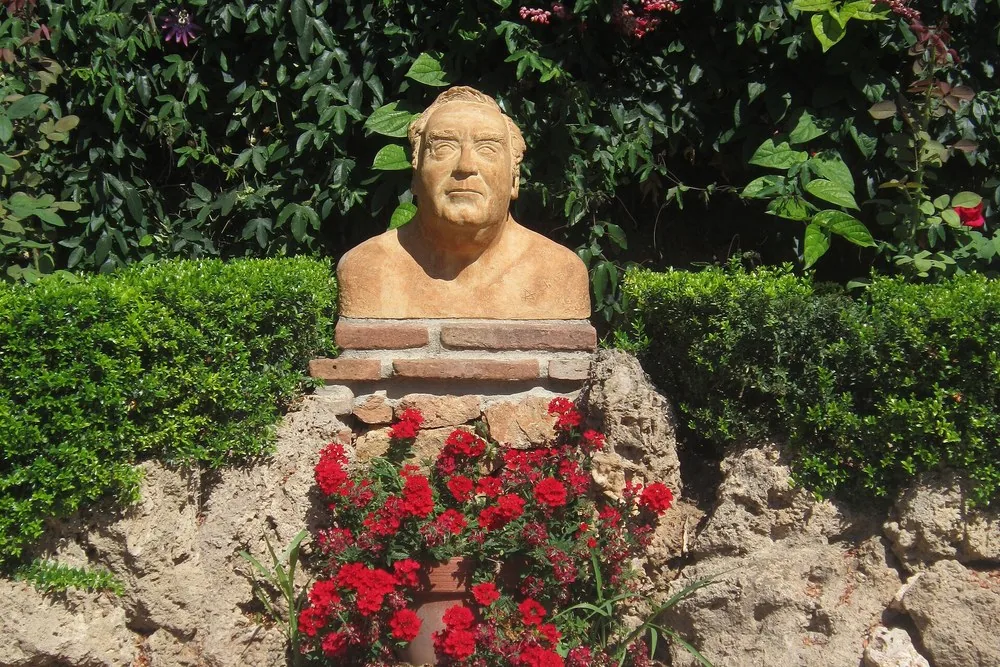
Dr Esteban Martín Martín was a retired physician. He was fascinated by Christopher Columbus and the history of Spanish exploration. Rather than write a book or commission an artist, he decided to build a monument. He chose a hilltop outside Benalmádena and began in 1987. He worked with two skilled bricklayers, Juan Blanco and Domingo Núñez. What began as a personal project became a seven-year obsession, mixing architectural styles deliberately — Byzantine, Romanesque, Gothic, and Mudéjar — to represent the four periods of Spanish history that produced the voyage of 1492.
The sixteen chapters carved in stone
The monument is essentially a building-sized sculpture telling the Columbus story in sixteen numbered episodes. Chapter 1 is marked with a visible plaque on the wall. Each chapter narrates an episode: Columbus's early life, his preparation, his pitch to the monarchs, the voyage itself, the discovery, and his legacy. The chapters are carved into the stone and integrated into the architecture. This is the angle of the monument — not a replica castle, but a narrative in stone. Nothing on site explains what the chapters mean. That is what the guide does.
The three ships built into the walls
Three ships are constructed into the monument's structure: La Niña, La Pinta (with a Pegasus marking Martín Alonso Pinzón, the ship's captain), and La Santa María. They are not models — they are architectural features, stone prows and hulls visible as you walk. The Pegasus on the Pinta is a personal touch, an element that adds specificity and shows Dr Martín's attention to detail.
The empty mausoleum and Columbus's remains
A Gothic rosette mausoleum was built inside the complex with the hope that one day it would hold the remains of Christopher Columbus. It has never been used. Columbus's remains are in Seville Cathedral, and there they remain. The mausoleum stands empty, a memento mori — a reminder that some intentions do not reach completion.
The smallest church in the world
Inside the complex is Santa Isabel de Hungría, a consecrated chapel recognised by Guinness World Records in April 1990 as the world's smallest church. It measures 1.96 m². It is not decorative. Weddings are held in it. It remains consecrated and active.
The pagoda and Asian symbolism
A Chinese pagoda and Hindu-influenced architectural elements are incorporated into the complex. These represent Columbus's actual goal — reaching Asia by sailing west. Failing to reach Asia but discovering the Americas instead, Columbus's voyage became history's biggest mistake that turned into success. The pagoda marks what Columbus was chasing.
Scale and ambition
The monument covers about 1,500 m², making it the largest monument to Columbus in the world by surface area. It is not a small sculpture or a nameplate. It is an architectural statement that required seven years and two skilled workers to complete. The detail is everywhere — the carvings, the symbolism, the deliberate mix of styles. Dr Martín exhausted his vision into stone.
Dr Martín's death and legacy
Dr Esteban Martín Martín died on 8 February 2001, about seven years after the monument opened. He did not see it become a tourist attraction or receive international recognition. He built it, finished it, and left. The monument remains his singular expression — not a career, not a commission, but a personal project by a retired doctor who had an idea and the stubbornness to see it through.
Frequently asked questions
Who built Castillo de Colomares?
Dr Esteban Martín Martín, a Spanish-American physician who retired and decided to build a monument to Columbus. He worked with two bricklayers, Juan Blanco and Domingo Núñez, from 1987 to 1994. Dr Martín died on 8 February 2001.
How long did it take to build?
Seven years, from 1987 to 1994. Dr Martín worked continuously with his two bricklayers, Juan Blanco and Domingo Núñez, on the stonework, carvings, and architectural detail. It is the world's largest Columbus monument by surface area, covering about 1,500 m².
What are the sixteen chapters?
The monument is built as a narrative in stone. Sixteen numbered episodes tell the Columbus story from preparation through discovery and legacy. Chapter 1 is marked with a visible plaque. A guide explains what each chapter represents; the monument itself carries no labels.
Why are there ships built into the walls?
Three ships are integrated into the architecture: La Niña, La Pinta, and La Santa María. They are not models but architectural features — stone prows and hulls you see as you walk. The Pinta bears a Pegasus, marking Martín Alonso Pinzón, the captain of that ship.